


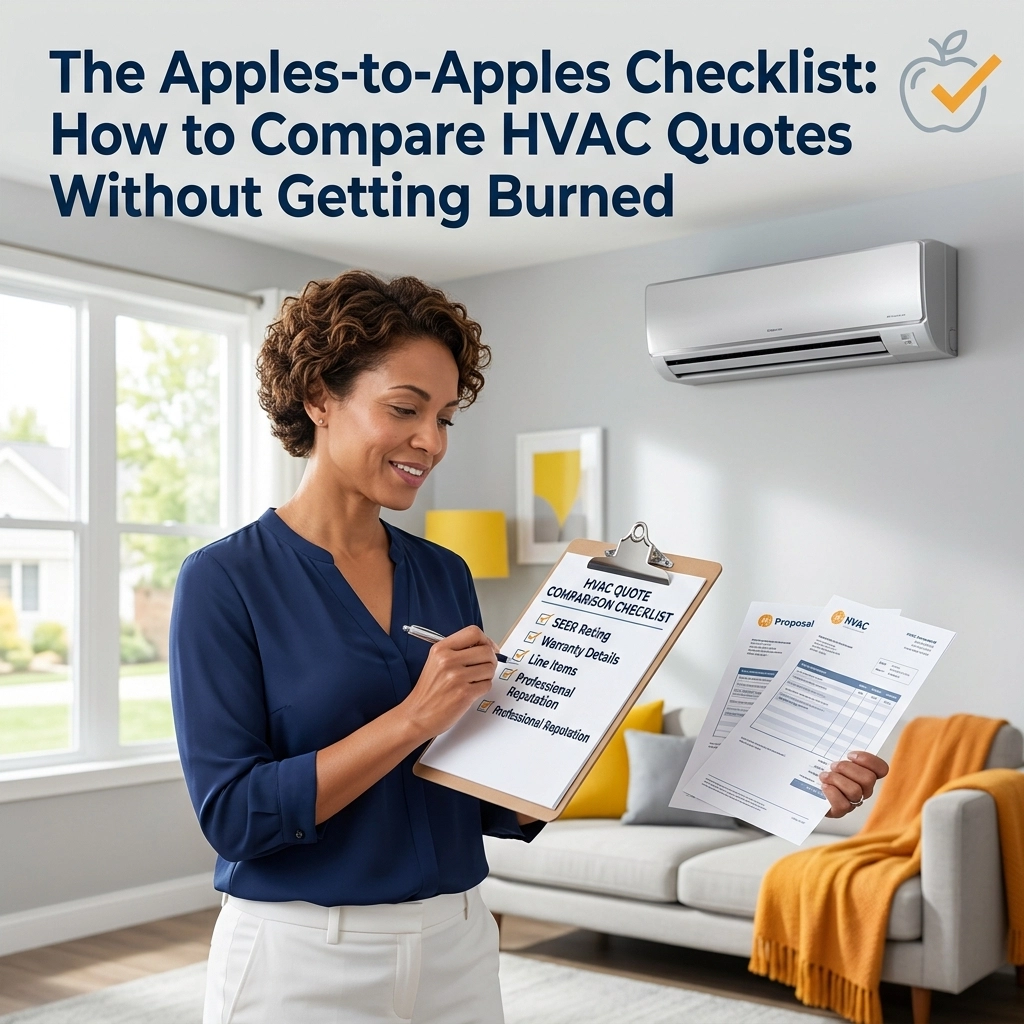
You’ve finally decided it’s time. That 20-year-old AC unit outside sounds like a helicopter taking off, and your furnace is making noises that suggest it’s possessed by a Victorian ghost. You do the responsible thing: you call three different local HVAC companies for quotes.
Then the emails hit your inbox.
Company A wants $8,000. Company B wants $11,500. Company C, the guy your neighbor’s cousin knows, says he can "do it for five grand and a case of beer" (okay, maybe not the beer, but it’s suspiciously cheap).
Now you’re sitting at your kitchen table in Tonawanda or Amherst, staring at three pieces of paper that might as well be written in ancient Greek. How can three "identical" jobs have a price gap larger than a Buffalo pothole?
The truth is, they aren't identical. At Evolution Heating & Air Conditioning, we see this every day. Most homeowners end up comparing a base-model "box" to a high-performance "system," and that’s how people get burned.
If you want to know what you’re actually paying for, you need an apples-to-apples comparison. Put down the highlighter and let’s walk through the ultimate checklist to ensure you’re getting real value, not just a low price that will haunt you for the next decade.
1. The "Eyeball" Estimate vs. The Math
If a technician walks into your basement, looks at your old unit for thirty seconds, and says, "Yep, looks like a 3-ton to me," run.
In Western New York, we deal with extreme temperature swings. A unit that is too big will "short cycle" (turn on and off constantly), which destroys your energy bill and leaves your house humid. A unit that is too small won’t keep up when August gets sticky.
The only way to know the right size for your home is through a Manual J Load Calculation. This takes into account your square footage, insulation, window types, and even which way your house faces.
The Checklist Question: Did they perform a computerized load calculation, or are they just guessing based on what’s already there?

2. Equipment Tiers: Are You Buying a Pinto or a Porsche?
This is where the biggest price gaps live. On paper, both quotes might say "16 SEER2 AC Unit." But there is a massive difference in how that unit actually runs.
- Single-Stage (The "On/Off" Switch): This is the basic model. It’s either running at 100% or it’s off. It’s loud, it’s less efficient, and it’s the cheapest option.
- Two-Stage: Think of this like having a "low" and "high" gear. It spends most of its time in the low gear, saving you money and keeping the temperature steady.
- Variable-Speed (The "Dimmer Switch"): This is the gold standard. It adjusts its output in tiny increments to match exactly what your home needs. It is whisper-quiet and offers the best dehumidification for those humid WNY summers.
If Company A quoted you a single-stage unit and we quoted you a variable-speed system, the prices shouldn't be the same. You’re comparing a window fan to a climate control system.
The Checklist Question: Is the equipment single-stage, two-stage, or variable-speed? What is the SEER2 rating? (And no, "standard" is not a technical term).
3. The "Hidden" Work: Don't Step Over a Dollar to Save a Dime
When you see a "too good to be true" price, it’s usually because the contractor is planning to "drop and swap." They pull the old box out, slide the new one in, tape it up, and leave.
At Evolution Heating & Air Conditioning, we believe the installation matters more than the brand of the box. Here’s the stuff the "cheap guys" often leave out:
Permits and Inspections
We recently talked about this in our Amherst AC post: skipping permits is a huge red flag. In places like Tonawanda and Grand Island, permits ensure the job was done safely. If a contractor says you don’t need one, they’re really saying they don’t want a professional inspector checking their work.
Electrical Upgrades
Modern high-efficiency systems often have different electrical requirements than your old 1998 dinosaur. Does the quote include a new outdoor disconnect and whip? If they’re reusing old, brittle wiring to save thirty bucks, you’re looking at a fire hazard down the road.
Proper Commissioning
This is the "secret sauce." Once the system is installed, it needs to be "commissioned." This involves checking refrigerant levels, testing airflow, and ensuring the static pressure in your ducts won't kill the blower motor in three years. This process takes time and expensive tools. The cheap guys usually skip it.
The Checklist Question: Does the quote include permits, new electrical components, and a documented startup/commissioning report?

4. Labor and Warranties: Who Answers the Phone in February?
Almost every major manufacturer offers a 10-year parts warranty. That’s standard. But here’s the kicker: Parts warranties don't cover labor.
If your compressor fails in year five, the part might be free, but the labor to replace it could cost you $1,500 or more.
The "guy with a truck" who gave you that rock-bottom quote probably offers a 1-year labor warranty: or worse, a "tailgate warranty" (once his tailgate leaves your driveway, the warranty is over).
At Evolution, we stand by our work. We offer robust labor warranties because we know our installation quality is top-tier. When you pay a bit more for a reputable company, you’re buying insurance against future headaches.
The Checklist Question: How many years of LABOR are covered? Is this company a "fly-by-night" operation or a locally owned business with a physical office?
5. The "Comfort" Factor (Ductwork and Filtration)
A new HVAC system is the heart of your home, but your ductwork is the circulatory system. If your ducts are leaky or undersized, even the most expensive furnace won't keep you warm.
Does the quote include a high-efficiency media filter, or are they sticking with the old 1-inch "rock-catcher" filters that do nothing for your indoor air quality? Are they sealing the connections with professional mastic or just cheap duct tape?
The Checklist Question: Does the quote address air filtration and ductwork modifications, or are they just slapping a new unit onto an old, dirty system?

Why Evolution? Because We Live Here Too.
We aren't a massive national franchise. We are locally owned and operated right here in Western New York. When we give you a quote for heating installation, we’re giving you a price that reflects the work required to do it right the first time.
We know the local codes in Kenmore, the quirks of the older homes in Tonawanda, and the expectations of homeowners in Amherst. We don’t do "cheap." We do value.
If you’re looking at a stack of quotes and your head is spinning, give us a call. We’d be happy to look them over with you: even if you don't choose us. We’d rather you be informed than get burned by a "low-cost" install that ends up costing you double in repairs.
Frequently Asked Questions
Q: Why is one quote $3,000 more than the others?
A: Usually, it’s a combination of higher-tier equipment (variable-speed vs. single-stage), more comprehensive labor warranties, and the inclusion of permits and necessary electrical/ductwork upgrades.
Q: Can I keep my old thermostat?
A: Maybe, but it’s usually a bad idea. Modern systems communicate with their thermostats to maximize efficiency. Using a 10-year-old thermostat on a brand-new variable-speed unit is like putting wooden wheels on a Ferrari.
Q: How long should an HVAC installation take?
A: A proper, high-quality installation usually takes a full day (8–10 hours) for a crew of two. If someone says they can be in and out in three hours, they are skipping the commissioning and testing phases.
Q: What is SEER2?
A: It’s the updated version of the Seasonal Energy Efficiency Ratio. As of 2023, the testing standards became more rigorous to reflect real-world conditions. Always look for SEER2 ratings on your quotes for an accurate comparison!
Ready for a quote that actually makes sense?
Don't settle for an "eyeball" estimate. Contact the pros at Evolution Heating & Air Conditioning today. We’ll provide a detailed, transparent proposal that shows you exactly where your money is going.
Contact Us Today | Check Our Coupons | See What Your Neighbors Are Saying