

When you live in Western New York, your HVAC system isn’t just a luxury, it’s a survival tool. Between the humid lake-effect summers and the bone-chilling winters that keep our furnaces humming from October through May, we put our equipment through the wringer. But there is one small, often overlooked component that stands between you and a massive repair bill: your air filter.
At Evolution Heating & Air Conditioning, we get asked all the time: "Hey, should I just buy the most expensive filter at the hardware store?" or "Is the cheap MERV 8 filter actually doing anything?"
It’s a great question. Choosing the wrong filter isn't just about air quality; it’s about the health of your furnace and AC. In this guide, we’re going to break down the MERV 8 vs. MERV 13 debate, talk about the "middle child" (MERV 11), and help you figure out what’s best for your specific home in Tonawanda, Kenmore, or Amherst.
What Exactly is a MERV Rating?
If you’ve ever stood in the filter aisle at a big-box store in Buffalo, you’ve seen the numbers. MERV stands for Minimum Efficiency Reporting Value. It’s a scale from 1 to 16 that measures how effectively a filter traps particles.
Think of it like a fishing net. A MERV 1 net has big holes (it’ll catch a boot, but the minnows swim right through). A MERV 16 net has tiny holes (it’ll catch everything, including the silt).
For residential homes, we almost always stay between MERV 8 and MERV 13. Here is why the rating matters to you:
- Low MERV (1-4): Mostly just protects the furnace from giant dust bunnies. Doesn't do much for your lungs.
- Mid-Range MERV (8-11): The "sweet spot" for most WNY families. It catches dust, pollen, and pet dander.
- High MERV (13-16): Hospital-grade filtration. It catches bacteria, smoke, and even some virus particles.
But here is the catch: and it’s a big one: higher isn't always better.
MERV 8: The Reliable Workhorse
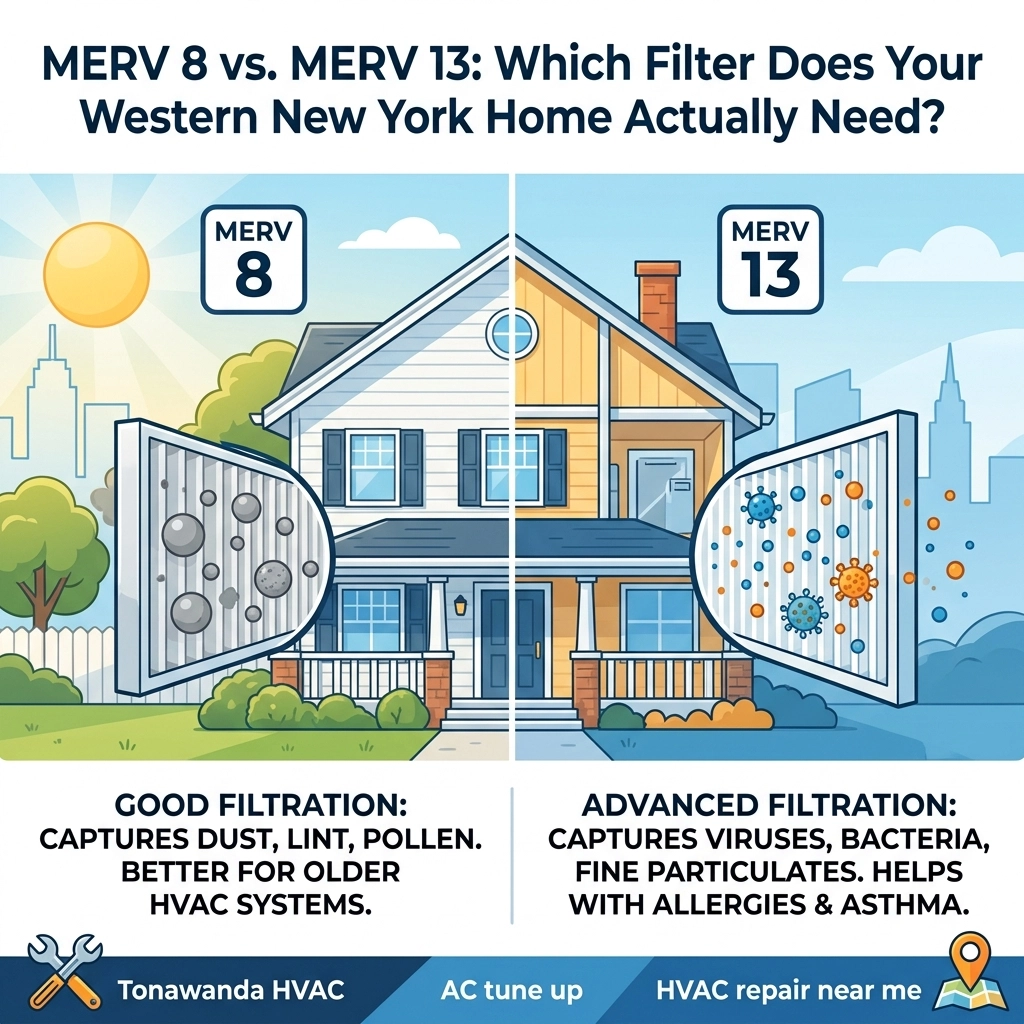
For most healthy households in Western New York, a MERV 8 filter is the standard for a reason. It provides a solid balance between cleaning the air and letting your HVAC system "breathe."
What it catches:
- Large dust particles and lint
- Pollen (crucial for those Buffalo spring blossoms!)
- Dust mites
- Most mold spores
The Pros:
In many older homes in areas like Grand Island or Kenmore, the ductwork wasn't designed for high-pressure filtration. A MERV 8 filter has low airflow resistance. This means your furnace blower doesn't have to work overtime to pull air through the filter. It keeps your energy bills lower and extends the life of your equipment.
The Cons:
If you have a heavy shedder (looking at you, Golden Retriever owners) or someone with severe asthma, a MERV 8 might leave a bit to be desired. It won't catch the microscopic stuff that triggers heavy-duty allergies.

MERV 13: The "Clean Air" Specialist
Lately, MERV 13 filters have become incredibly popular. With the increase in Canadian wildfire smoke drifting down to Western New York over the last few summers, many of our customers are looking for that extra layer of protection.
What it catches:
- Everything a MERV 8 catches, plus…
- Bacteria and microscopic allergens
- Fine pet dander
- Smoke particles
- Virus carriers (aerosols)
The Pros:
If you live near a busy road in Niagara Falls or have someone in the house with COPD or severe allergies, a MERV 13 is a game-changer. It significantly reduces the "stuff" floating in your air. It’s also great if you use a wood-burning fireplace in the winter, as it helps trap those fine soot particles.
The Cons (The "Warning" Part):
This is where we have to put on our "Expert HVAC Pro" hats. A MERV 13 filter is thick. It’s dense. Imagine trying to breathe through a thick winter coat versus a light t-shirt.
If your HVAC system is older or wasn't designed for that level of restriction, a MERV 13 filter can actually damage your system. It can cause:
- Reduced Airflow: Your house won't get as warm or as cool as it should.
- Frozen AC Coils: In the summer, restricted airflow can cause your air conditioning unit to freeze into a block of ice.
- Blower Motor Burnout: The motor has to work twice as hard, leading to a premature (and expensive) death.
The Western New York Factor: Why Your Location Matters
In Western New York, we deal with unique environmental factors that affect your choice.
1. The "Old House" Problem
We have some beautiful historic homes in WNY. However, older homes often have smaller ductwork. If you shove a MERV 13 filter into a 1940s-era furnace system, you’re asking for a breakdown. We usually recommend sticking to a high-quality MERV 8 or MERV 11 for older setups.
2. Lake Erie Humidity & Mold
Our summers are humid. Humidity breeds mold. Because a MERV 13 captures more mold spores, it will clog up much faster than a MERV 8. If you don't change a MERV 13 filter every 30-45 days during a Buffalo summer, it can become a wall of gunk that shuts your system down.
3. Allergy Season
Buffalo has a massive variety of trees and grasses. If you suffer from the "Buffalo Sniffles" every May, moving up to a MERV 11 is often the perfect compromise. It gives you more protection than a MERV 8 without the extreme airflow resistance of a MERV 13.
Pet Owners & Allergy Sufferers: Pro Tips
If you share your home with furry friends, your filter is doing double duty. Here’s what we recommend:
- Don't just go higher, go more frequent. A dirty MERV 8 is worse than a clean MERV 8. If you have two dogs and a cat, check that filter every single month.
- Visual Check: Take the filter out and hold it up to a light. If you can’t see light through it, it’s a brick. Replace it immediately.
- Consider an Air Purifier: If you need MERV 13 levels of cleaning but your furnace can’t handle it, keep the furnace at a MERV 8 and buy a standalone HEPA air purifier for the bedroom.
Is your AC struggling with a thick filter? Book an AC Tune-Up today to make sure your airflow is where it needs to be!
Signs Your Filter is Too Restrictive
Not sure if your system is struggling with that fancy new MERV 13 you bought? Look for these red flags:
- Whistling Noises: If your vents are "screaming," the system is literally gasping for air.
- Short Cycling: The furnace turns on, runs for three minutes, then shuts off. This is often a safety limit switch tripping because the unit is overheating.
- Dusty Vents: Counterintuitively, if a filter is too thick, air might "leak" around the edges of the filter frame, sucking unfiltered air (and dust) directly into your vents.
- Rising Bills: If your National Fuel or National Grid bill is creeping up for no reason, your motor might be working too hard.
Why Choose Evolution Heating & Air Conditioning?
At Evolution Heating & Air Conditioning, we are "Big Enough to Serve, Small Enough to Care." We are a locally owned and operated business right here in WNY. We know the difference between a furnace in a Grand Island ranch and a boiler in a North Tonawanda colonial.
We offer 24/7 Emergency Service because we know that furnaces don't break at 2:00 PM on a Tuesday: they break at 2:00 AM on a Saturday when it’s 5 degrees outside.
Whether you need a simple filter recommendation or a full AC installation, we treat your home like it’s our own.

Frequently Asked Questions (FAQ)
Q: How often should I actually change my filter?
A: For a standard 1-inch MERV 8 filter, every 2-3 months. For MERV 11 or 13, check it every month. If you have pets, check it every 30 days regardless of the rating.
Q: Can I use a washable filter?
A: We generally don't recommend them for most WNY systems. They tend to have very low MERV ratings and, if you don't let them dry completely, they can actually grow mold inside your furnace.
Q: Where can I find the MERV rating on my filter?
A: It’s usually printed right on the side of the filter frame along with the dimensions (e.g., 16x25x1).
Q: Is MERV 11 better than MERV 13?
A: "Better" depends on your system. MERV 11 is the best "all-arounder" for most modern homes in our area. It provides excellent filtration without the high risk of system strain.
Don’t Guess: Get an Expert Opinion
Choosing between MERV 8 and MERV 13 doesn't have to be a headache. If you're worried about your indoor air quality or you've noticed your system acting up, give us a call. We serve Tonawanda, Kenmore, and the surrounding Western New York area with pride.
Ready for a more comfortable home? Contact Evolution Heating & Air Conditioning today!